I have very fond memories of my childhood playing board games with my parents, mainly Monopoly. When my eldest turned 3 I began playing various smaller games with him and found he was a kindred gamer. As he grew his gaming interests quickly grew to. Before I knew it he was mastering Chess, Monopoly and many others. Today we play games most days and it is a wonderful way to connect as a family with the added bonus of all the learning involved in each game. If you’re new to this learning style you might like to read how games can help your children learn below.
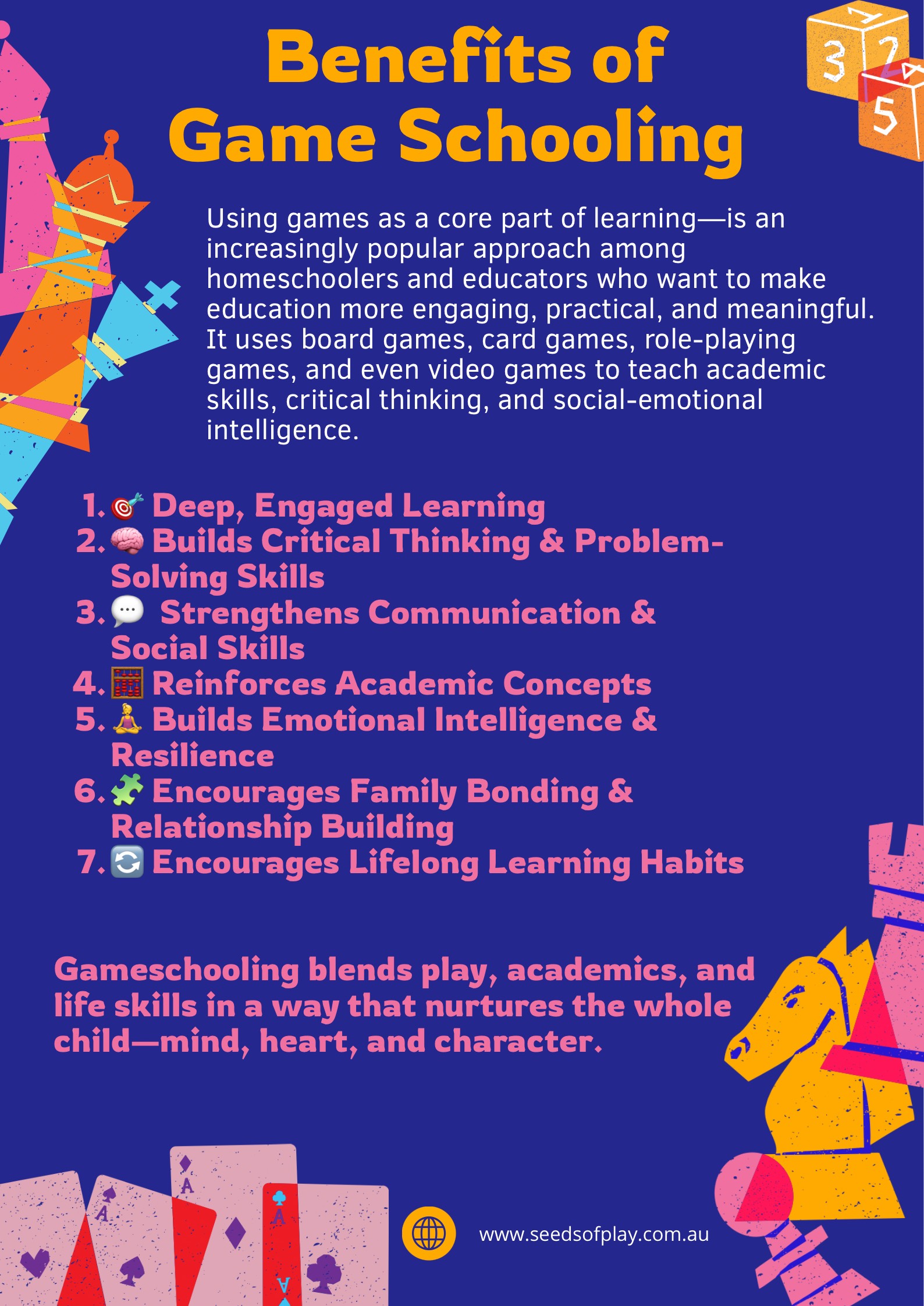
🎯 1. Deep Engagement and Motivation
- Games make learning fun and purposeful, which naturally increases a child’s motivation.
- The sense of challenge, progress, and accomplishment in games keeps learners interested longer than traditional worksheets or lectures.
🧠 2. Critical Thinking and Problem-Solving
- Many games (board games, strategy games, simulations) require planning, reasoning, and decision-making.
- Players must adapt, analyze outcomes, and develop strategies — skills that translate directly to real-world problem-solving.
💬 3. Social and Emotional Learning
- Multiplayer games teach communication, cooperation, patience, and empathy.
- Children learn how to handle winning and losing gracefully, negotiate, and take turns — all vital social skills.
📚 4. Academic Reinforcement Across Subjects
Games can align with virtually any subject area:
- Math: Prime Climb, Math Dice, Monopoly
- Language Arts: Scrabble, Bananagrams, Dixit, Alphabet Bingo
- History & Geography: Timeline, 7 Wonders, Ticket to Ride, Australia
- Science: Cytosis, Evolution, Planet
They turn abstract concepts into tangible, memorable experiences.
🧩 5. Creativity and Imagination
- Storytelling and role-playing games encourage imaginative thinking and narrative skills.
- Building and simulation games (like Minecraft or LEGO Education kits) nurture creativity, design thinking, and innovation.
⏳ 6. Development of Executive Function Skills
- Games often require planning, working memory, impulse control, and flexibility.
- These cognitive skills are crucial for success in school and beyond.
🏠 7. Strengthened Family and Peer Bonds
- Playing together fosters connection and collaboration.
- It provides families with shared experiences that build trust and communication, making learning a joyful group activity.
💡 8. Growth Mindset and Resilience
- Games provide a safe environment for failure and retrying, teaching persistence and resilience.
- Kids learn that mistakes are part of the process — not something to fear.
- It also gives children the chance to win and achieve at something or be in charge of something in a world where they have little choice.
🌍 9. Real-World Application
- Many games simulate real-life scenarios (economics, city-building, ecology), allowing learners to apply knowledge in practical, meaningful contexts.
- This helps bridge the gap between theory and practice.
🧭 10. Customizable and Child-Led Learning
- Games can be chosen to fit a child’s interests, learning style, and ability level.
- This autonomy fosters intrinsic motivation and a lifelong love of learning.
At Seeds of Play our tutoring service provides a myriad of hands on games for children to learn and socialise, along with skilled Teachers to help them navigate the tricky skills being learnt in the games.
Would you like a comprehensive list of our favourite games and the learning that my children get out of each game? Head on over to our Downloads page to download our FREE guide.
Share this post:
